My work for ‘DRIVERS’ , a Computer Arts Society (CAS) committee show

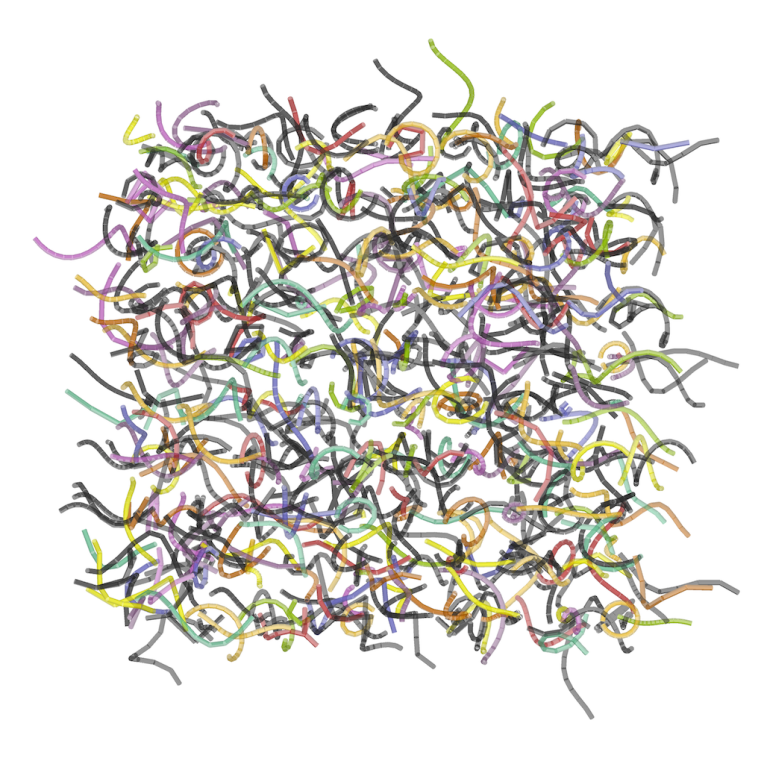
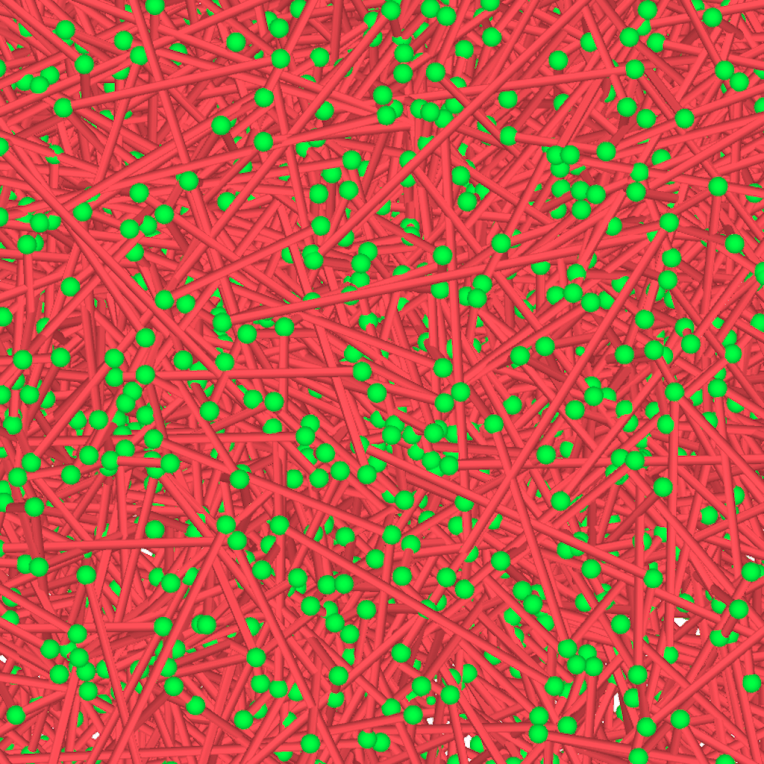
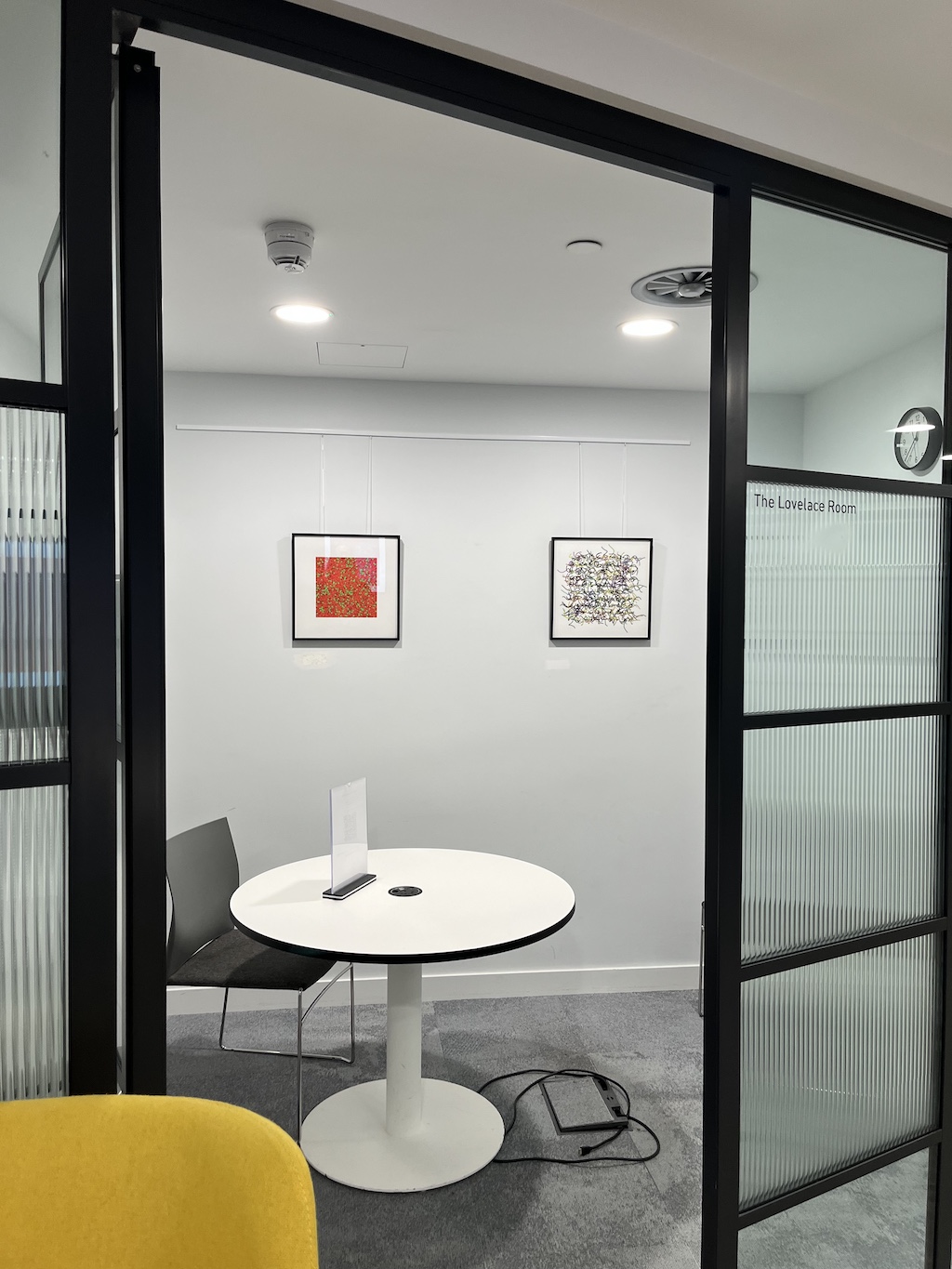
In September 2025 an exhibition of work by members of the CAS committee was installed at the London offices of the BCS in Moorgate. I had the privilege of curating the show. As a committee member I also chose to show some work. Having previously used C++ and OpenGL, for the show I used Processing for the first time to produce 3D animations to be screened as well as the images below, which were printed and framed. Two videos were formatted for the four screen video wall. There are links to view them below.
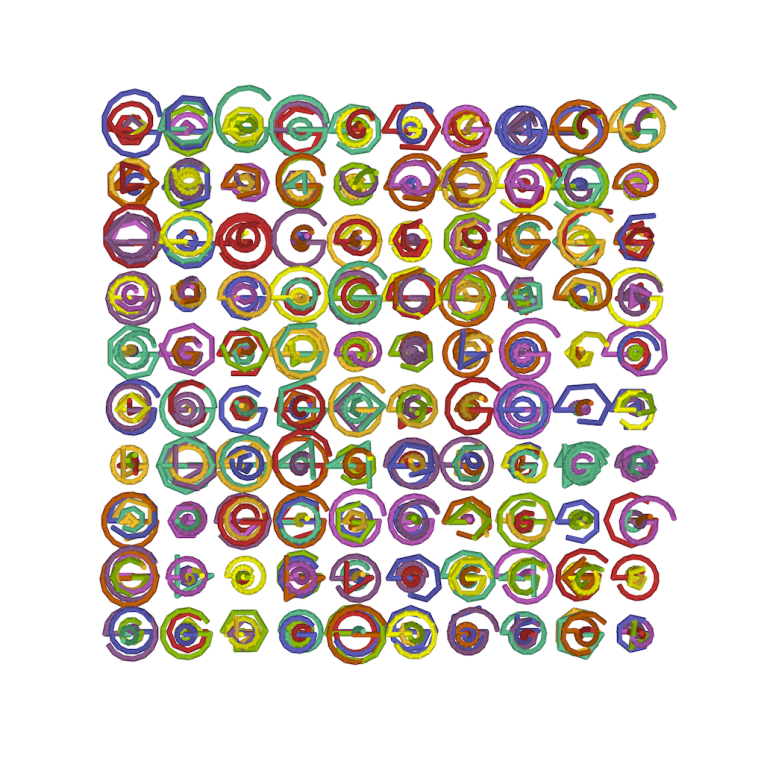
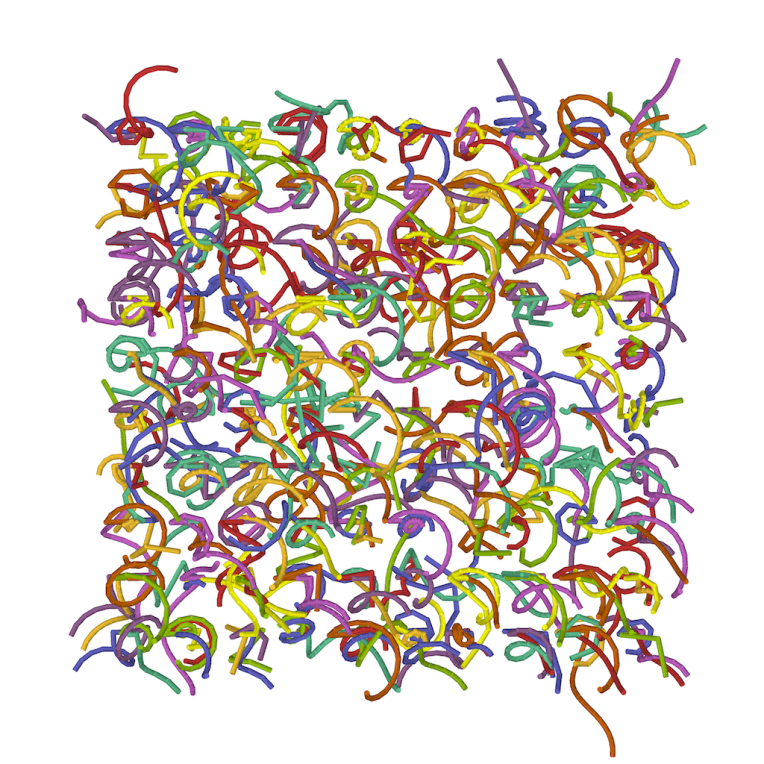
Following the example of colleagues I decided to make some new work, but related to some very old work. After a break of some fifty years, I returned to exploring the algorithms that I used back in the late nineteen-seventies first with physical sculptural constructions at Bristol Poly and then using computer graphics as a postgrad at The Slade. Back then, I used FORTRAN on a Data General Nova minicomputer. This time I used Processing on an iMac.

The algorithm is explained in the pages on my old website about my early computer graphics: https://stephenbell.org.uk/ranstak/index.html

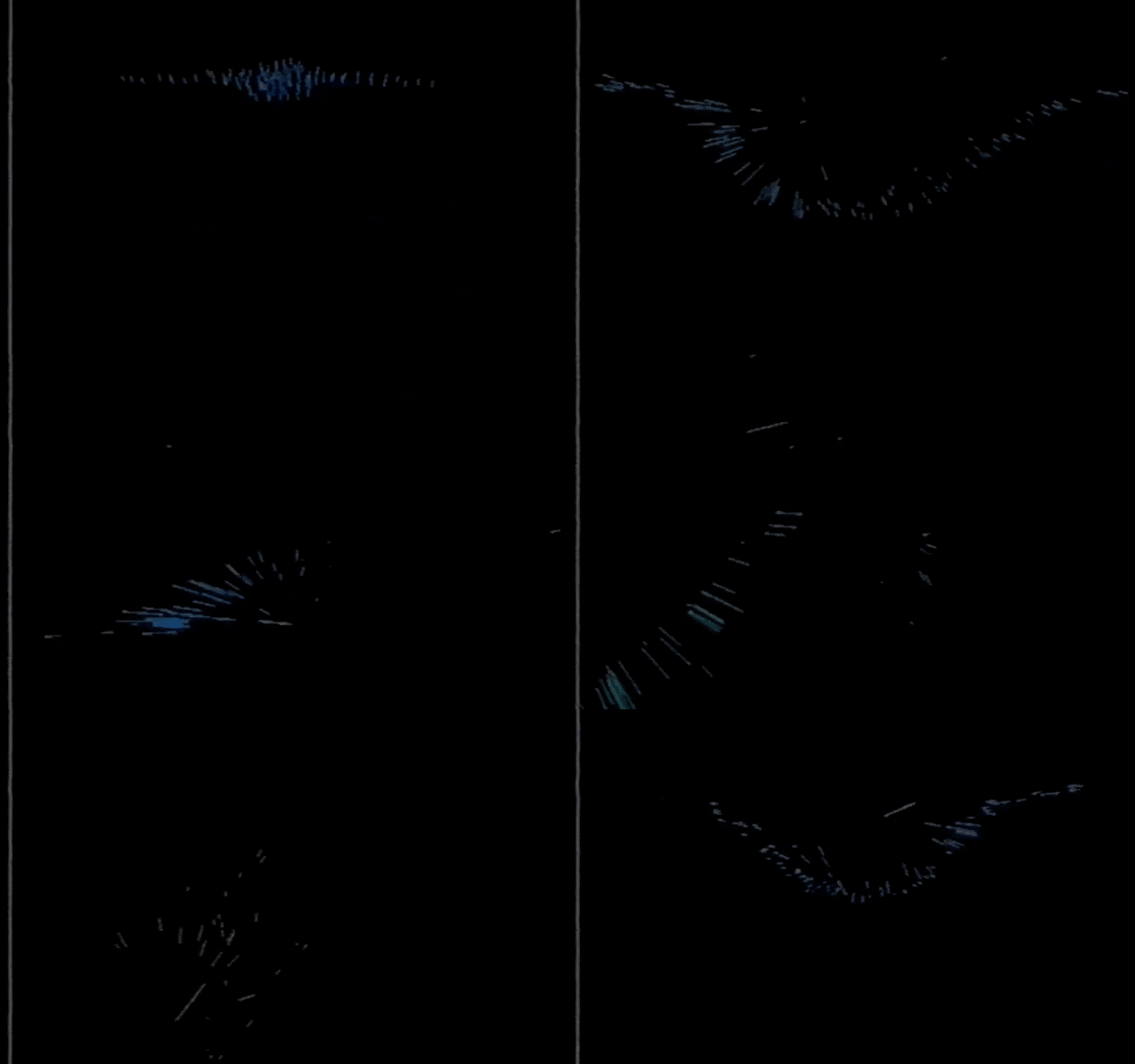
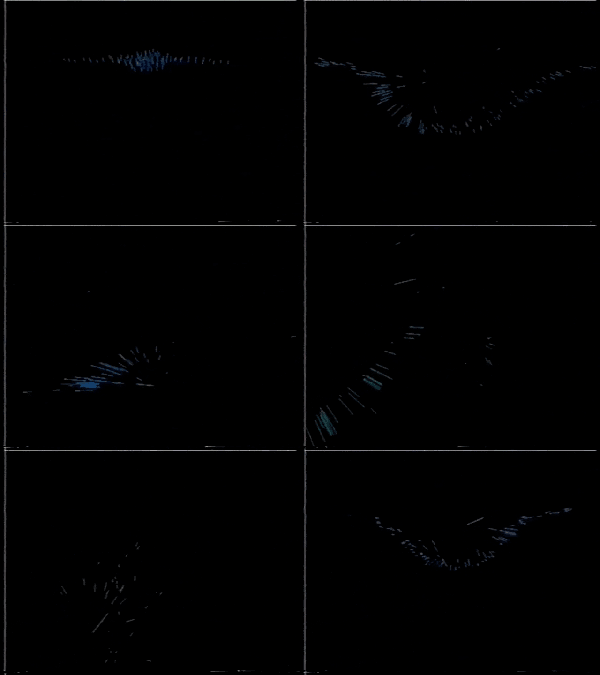
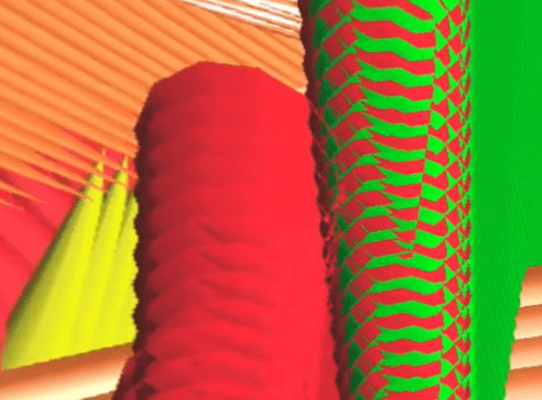
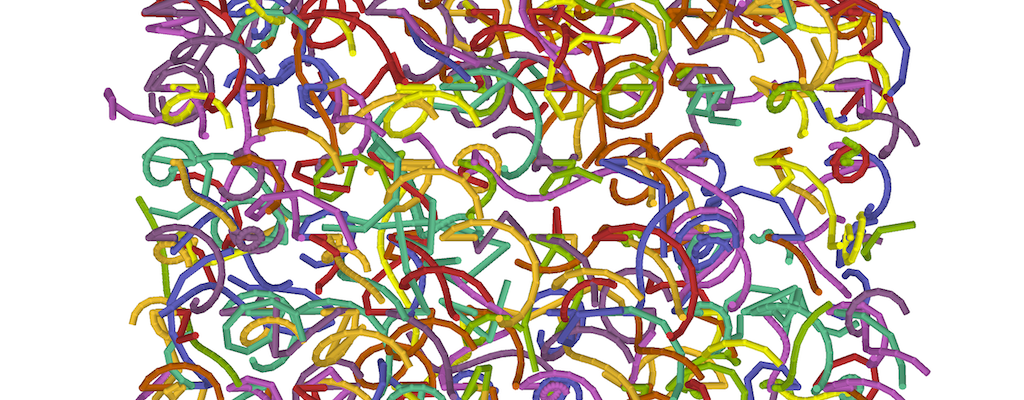
Two videos were made for the four-screen video wall at BCS Moorgate. A matrix of rotating helices of random length, frequency and amplitude provide constantly changing apparent conjunctions and combinations of shape as their overlapping forms coincide. The phases of the piece – where coloured shapes are replaced temporarily by monochrome ones and then replaced in turn by more brightly coloured helices is roughly based upon the menstrual cycle. Each video was generated using a different random number seed for the pseudo-random number generator, leading to different instances of the potential compositions.
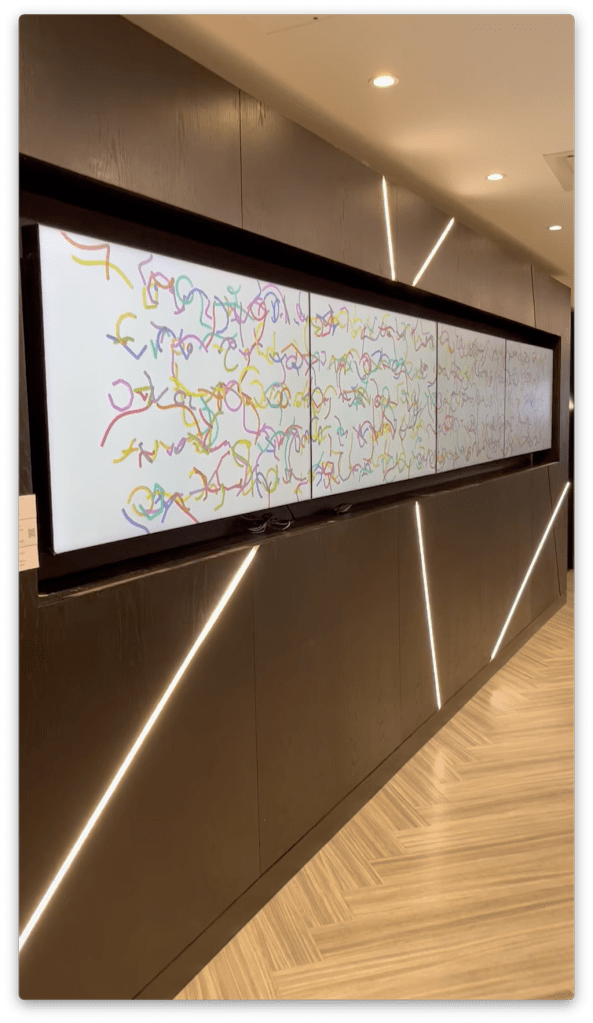
View of four screen video wall displaying helical conjunctions video
Looking into a small office with a glass door open and two prints on the wall.

Using Processing, which I only started learning this year, with help from the Google Gemini ‘AI’, rather than using a pen plotter the images are created using on screen rendering of the 3D geometry. A bonus of current technology compared to what I used in the 1970’s is that I can now produce animations of the shapes much more easily.
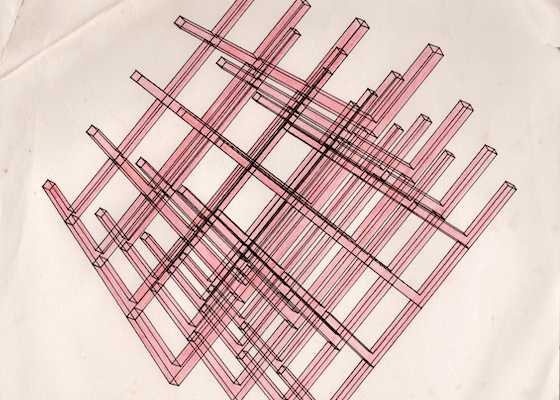
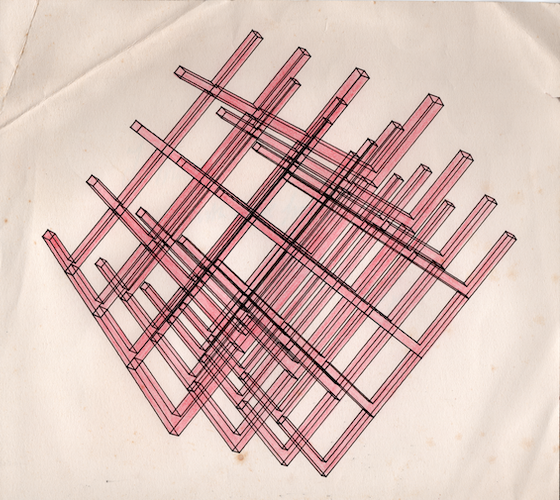
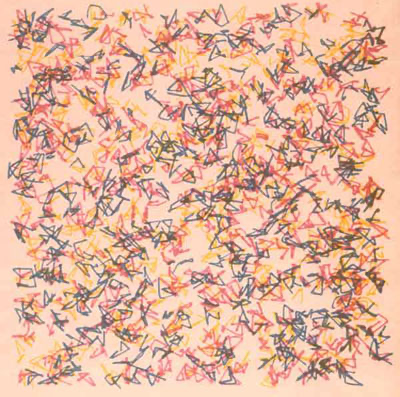
Very Early plotter drawing

4 x 4 x 4 arrangement of L shaped objects coloured with red pencil

In sorting through my mother’s estate after her recent demise I came across a birthday card that I had made for her when I was first using the computer at The Slade. It would probably have been 1978.

4 x 4 x 4 arrangement of L shaped objects coloured with red pencil

The first project that I did using the computer was based upon the sculptures that I had been making on my undergraduate course at Bristol Polytechnic. I had been arranging ‘modules’ in a regular grid pattern on the ground. Using the computer I was able to arrange them in 3D space without worrying about gravity. Note that the graphics library we used at the time did not have a hidden line removal option, hence the ‘wireframe’ rendering. I began to enjoy the ambiguity caused by the perspective projection of 3D shapes onto the 2D plane of the drawing. Fascinated by the way we see stars as if on a hemispherical surface, I had explored the phenomenon at Bristol with a model of the nearest twenty stars to our sun. I later transferred that data to computer drawings too.

There’s more about my early computer graphics here: https://stephenbell.org.uk/ranstak/index.html

Leicester computer art pioneers

There are a couple of prints of my work in the CAS: Leicester Computer Art Pioneers exhibition at Phoenix Leicester from November 2nd 2023 to January 30th 2024. The curator, Sean Clark, invited me to submit two pieces – one from the period when I was living in Leicester while I was working at the Loughborough University of Technology Computer-Human Interface Research Centre (LUTCHI) and studying for a PhD, and one recent piece. He would take the files I sent to him and produce prints for the show.

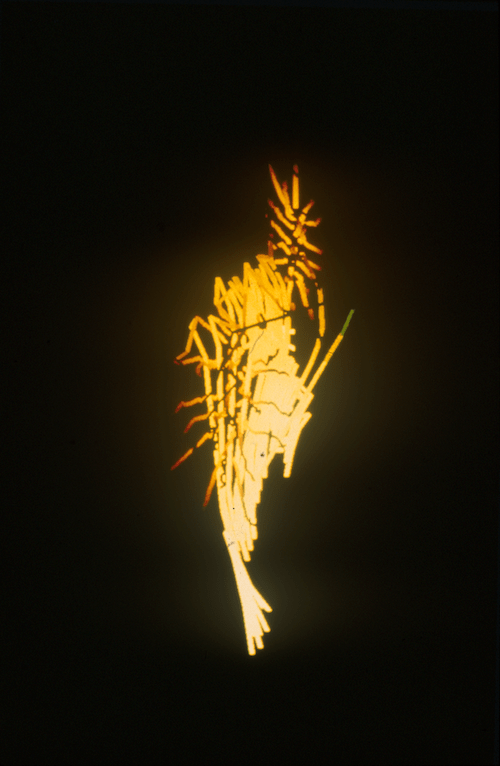
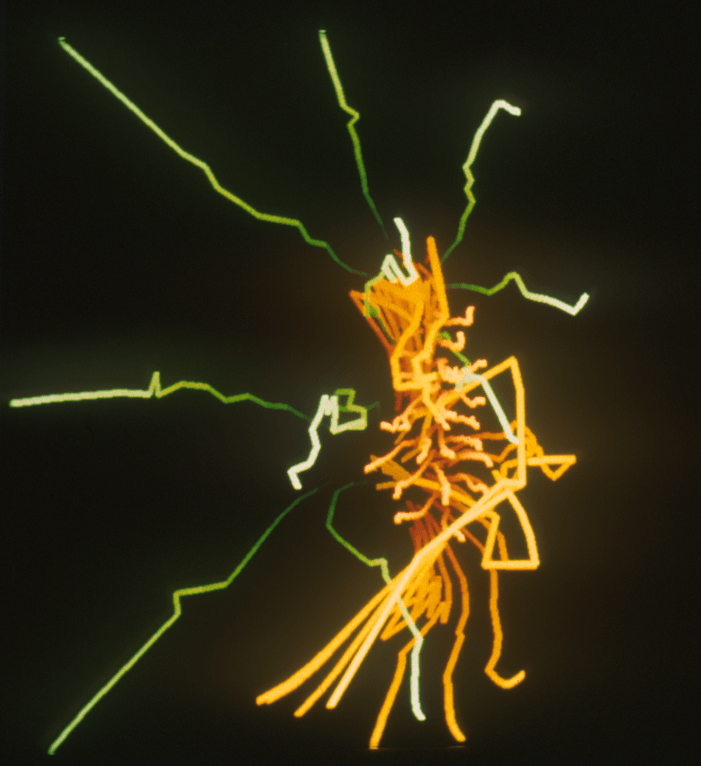
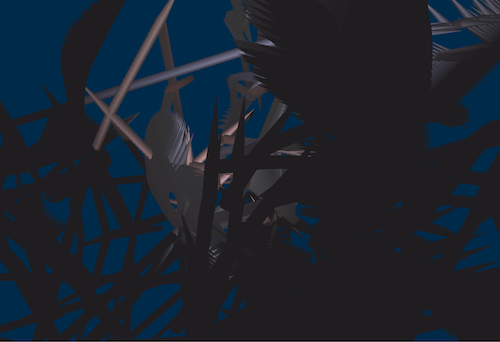
For the first piece I chose to combine two images that had been generated using the version of Smallworld that I was using on a Silicon Graphics IRIS workstation that I had borrowed from the centre to use in the shared house I lived in on Humberstone Road. When working on what came to be Prospero and Caliban I seem to remember listening to a radio broadcast of The Tempest. When searching online to find a record of the BBC broadcasting however I couldn’t find a reference to it, so perhaps my memory is playing tricks.

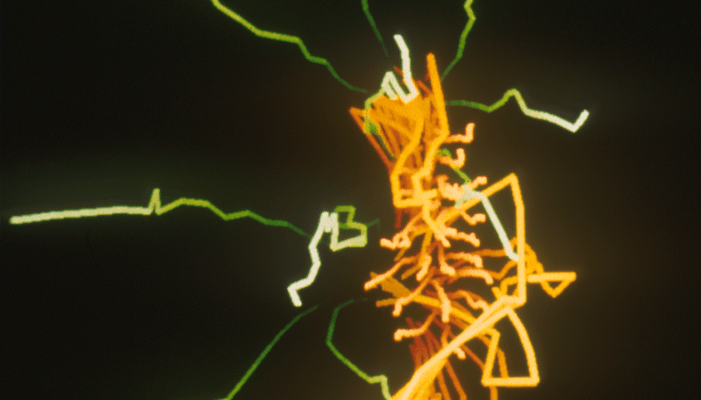
Nevertheless for the second piece I decided to make an image using my current iteration of the behavioural image generation programs that have followed from Smallworld, running on an iMac, to use a similar technique to the one I had been experimenting with when making the Prospero image, i.e. placing the source to illuminate the generated shape in the centre of the composition so that trails in front of the light source would be rendered in silhouette. The result is Miranda. The video below shows a recording of my exploration of the generated shape including the frame that I selected for the print.

The works exploit the perceptual phenomenon referred to as pareidolia, where people think that they can see something that does not actually exist. I have often sought out these phenomena, after learning of the advice of Leonardo da Vinci when I was at school.

Computer Arts Society members exhibition

predator prey trails stroyboard
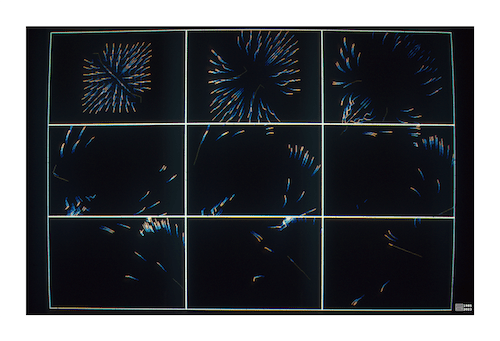
2 predators 98 prey, computer generated image, 1985

When asked to exhibit a piece in the inaugural CAS members’ exhibition I decided to submit a piece from my time as Artist in Residence at UKC (University of Kent at Canterbury) in the mid 1980’s. The piece is a version of a number of works in which I used the Smallworld suite to generate images based upon predator-prey behaviors. The piece exhibited uses a storyboard approach to show the way a regular arrangement of ‘prey’ are dispersed when two ‘predators’ move in on them.

Note that the image was photographed from a curved CRT screen as high quality digital printing was hard to come by at the time, hence the distortion.

More work from the time can be seen on my old website.

AI and art

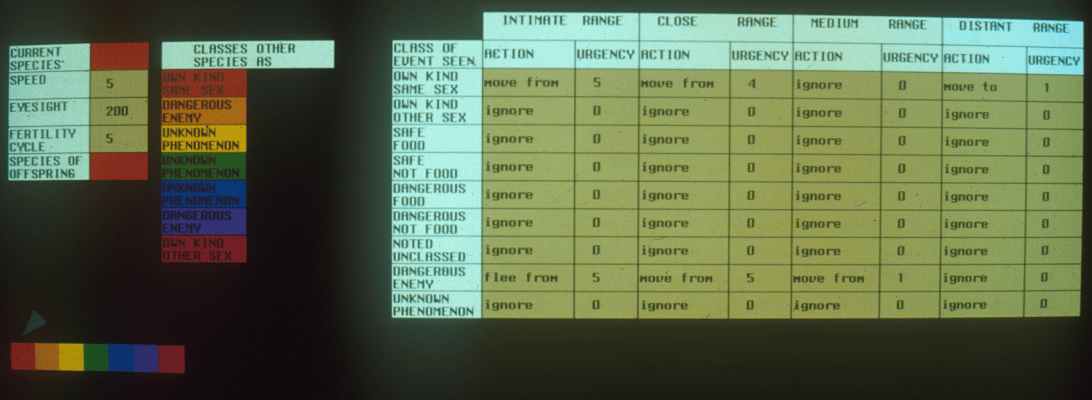
Some artists have been using AI techniques for decades, a particularly well known one being Harold Cohen, who made work using a system that he called AARON. I have been using a form of AI in my work since at least the mid 1980’s. I have not however been using machine learning techniques of the type that are currently getting an enormous amount of attention in popular media. My programs use state engines and state transition tables to create agent-based systems for image generation. This type of AI technique has been exploited in an enormous number of contexts, not least in games and digital effects. The ‘animals’ in my Smallworld programs are like game ‘bots’. The main reason for using these simple techniques is because I am fascinated by the compositions that can be created using them. Combined with this has been a desire to explore, question and celebrate the way that we can respond to automatic phenomena as if they were caused intentionally. The automatic agents in my programs (that I have referred to variously as animals, creatures, bees and so on) are not only intended to generate shapes and forms that have aesthetic effects related to organically generated forms like plants and other living organisms but also to present behavioural characteristics similar to those of actual animals.  The intention is that we might read more into them than is actually there and know that we are doing so. To me a key element in experiencing the work is thinking about the way that the apparently organic cause of the appearance of the compositions, or the impression that the ‘animals’ are intelligent, is an illusion constructed by us. We imagine it as we try to make some kind of sense of what we are looking at.

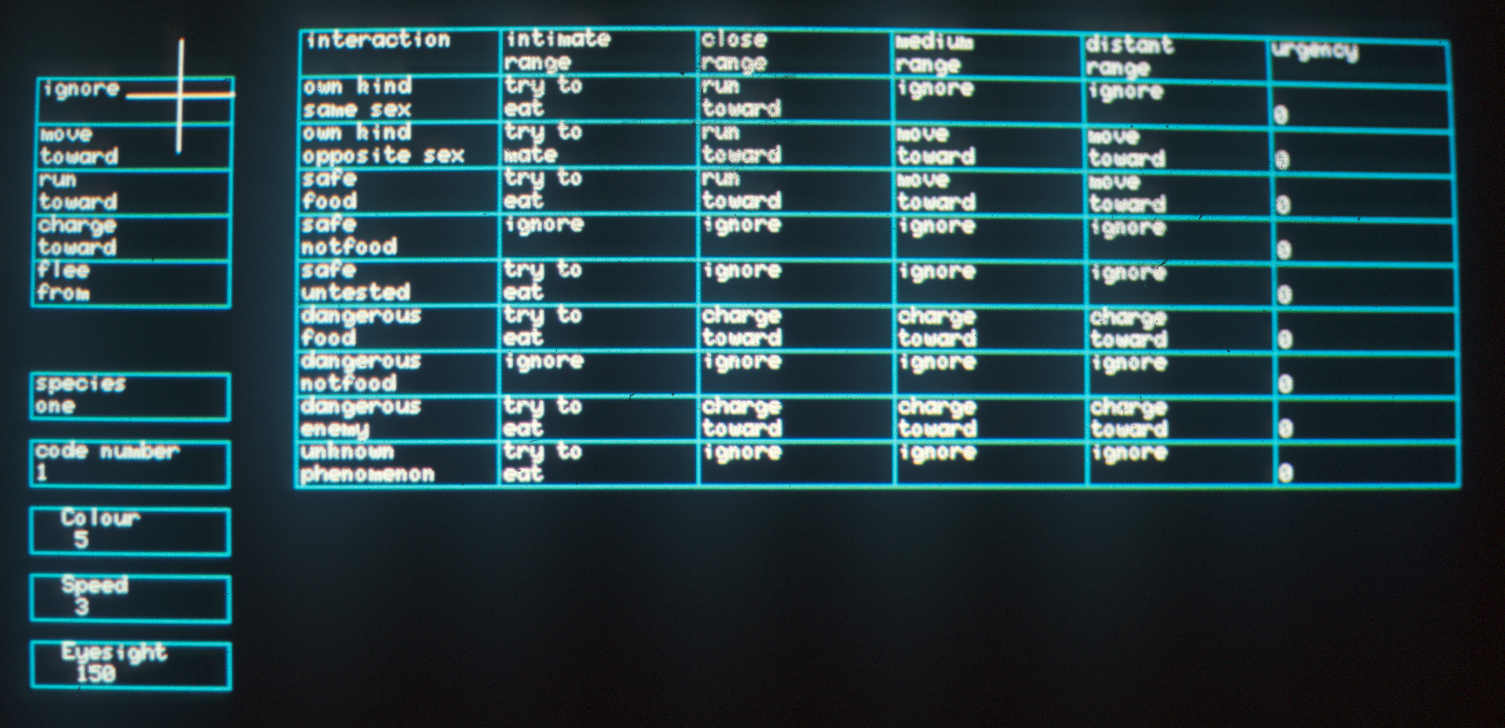
Early Smallworld species design interface including state transition table

The current controversy caused in the media by the promotion of programs that generate images, texts, music, etc. using deep learning techniques seems rather surprising. It is as if artists have never used AI techniques before. Speculation appears to be being fed by the idea that the programs are the artists, rather than being tools used by artists. The fact that the programs have been created by humans can evoke age-old visceral fears and ethical doubts, envisaging hubristic consequences of the creation of devices capable of artificial human-like activity. The potential of making autonomous artificial humanoids is also being alluded to.  One example that seeks to draw attention to and encourage discussion of this issue is the Ai-Da project which does so by using current technology to present a new riff on the rich history of constructing art-making humanoid machines.

The latest achievements will I hope lead to some original discussions rather than simple repetition of previous arguments. To achieve more depth in such discussions, it would be valuable to acknowledge that these new developments are not happening in an historical vacuum. There are precedents which should inform the discussion so as to lead to more satisfying conclusions.

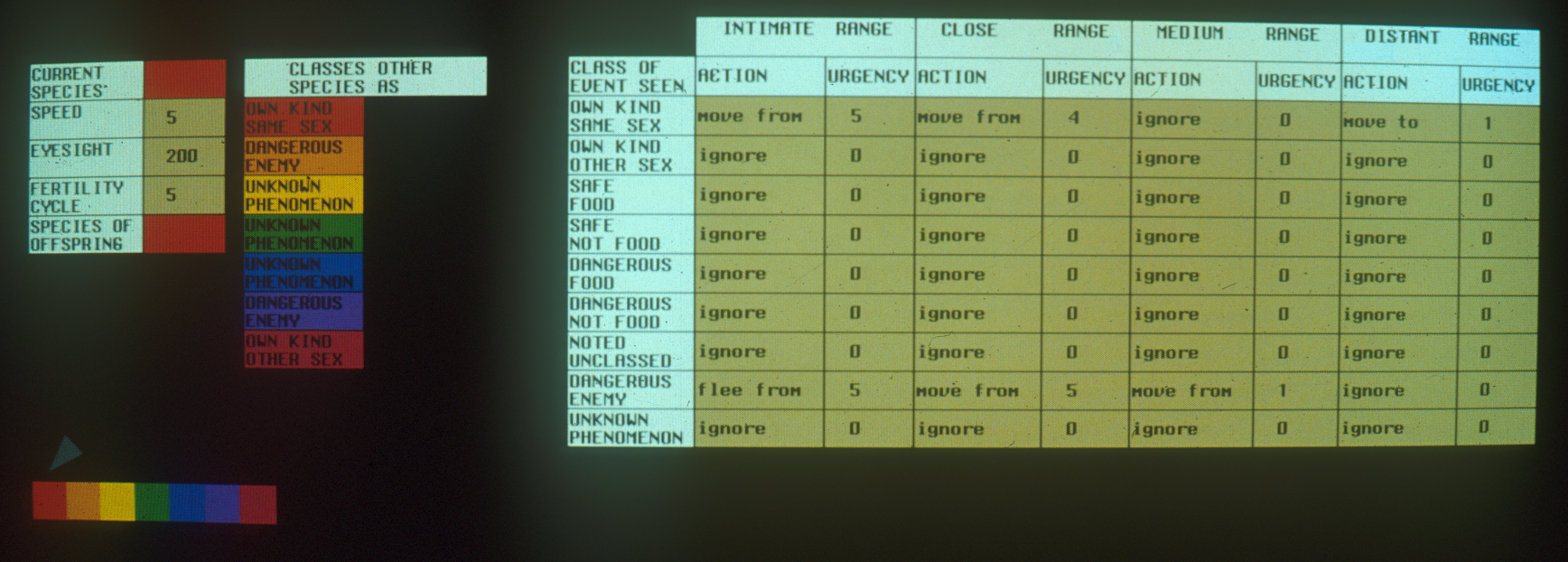
Later Smallworld species design interface with urgency for each event

From my experience using “Good Old-Fashioned AI” (GOFAI) in my work suggests that the use of the techniques currently being promoted in the creative arts should not be too great a problem, in fact it may open possibilities. The surge of interest seems to be due to the apparent ease with which the programs can be used, as well as their effectiveness at generating products that could plausibly be the product of human creativity alone. Personally, I have found most of the work that I have been aware of being produced using these currently celebrated techniques superficial or aesthetically repulsive. It reminds me of something Harold Cohen said about the way artists need to embrace “difficult to use” technology. Thus, expertise developed through practice in using these new tools will be needed to produce anything of real worth. There are still issues to be resolved around what AI technology might be used for, including imitating human activities and the creation of human facsimiles more convincing and hence potentially misleading than game bots. It would surely be instructive when addressing these questions, to consider what has gone before.

Sydney exhibition and PhD

I am very pleased to have some of my work in the exhibition Prisms of Influence: Echoes from The Colour in the Code at the Mosman Gallery in Sydney Australia. The exhibition runs in parallel to Ernest Edmonds: The Colour in the Code a retrospective exhibition at Mosman of Ernest Edmonds’ work. Ernest was the director of research of my PhD and Susan Tebby, who also has work in the show, was my supervisor.


My work in the exhibition is a video that, through recordings of interactions, shows the development of the interface I created to enable people to explore the generative properties of the Smallworld algorithms that I had developed at UKC. The development of versions of the Smallworld suite that people could access at exhibitions served as a case study in the focus of my PhD. The goal of my research which was to find out just what artists and audiences are offered by a medium that may demand active participation in the realisation of the work rather than, as is more often the case, engagement in viewing and interpretation of existing material.

A pdf of the PhD thesis, which includes the conclusions of the research, is available to download here.

dealing with the ephemeral

From what I have experienced, the technology that I and others have used to make work that is intended to be seen on screen and sometimes interacted with can and does become outdated. The machines can simply break and no longer be manufactured or they can be victim to what I would call a ‘classic’ issue in that when operating systems are updated some programs no longer work.

For quite some time now, I have believed what had been a working hypothesis when I started programming in the 1970’s – that there is a real similarity between the algorithms used to make these works and musical compositions or plays. At The Slade, I was in the company of artists in the Systems Group and other people influenced by them. Their work and previously whilst at Bristol Polytechnic the work of artists like Yoko Ono, Sol Lewitt and others had convinced me that works of art could consist of instructions, or rely upon instructions to generate them. Some of my contemporaries at Bristol had been influenced by the work of Kenneth Martin and together, encouraged by our tutors, we explored the ideas of the Systems Group. There was a real fascination at the time with implications of minimalism and work created without making decisions during execution. Instructions, like musical compositions, can of course be reinterpreted. One way therefore of dealing with the apparent impermanence of the work is to treat it as a composition to be performed. Performance may consist of making artefacts.

Using the basic principles of Smallworld is like taking a musical composition and playing it, possibly rearranging it and so on. I have taken various elements of the Smallworld suite and re-used them. In much the same way that musical composers, writers, poets and users of other media continue to explore how similar elements and proposals can reveal new aspects if differently combined. It is this kind of practice that led me to believe that working like I do sits very easily within established art practice.

It is worth remembering that when I was at Art College many artists had an ambiguous relationship with, if not complete antagonism towards the commercial art market. Artists were endeavouring, with varying degrees of success, to make art that could not be turned into a commodity. As a student this had also made an impression on my willingness to make ephemeral work alongside work that might last.

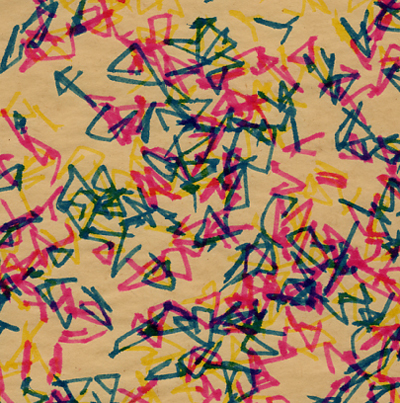
Detail of a brushpen plotted drawing on newsprint, a paper that I knew would change over time, leading to colour changes, the ink also was likely to fade, revealing new qualities as it did.

Leicester digital art pioneers

Exhibition and Zoom Event

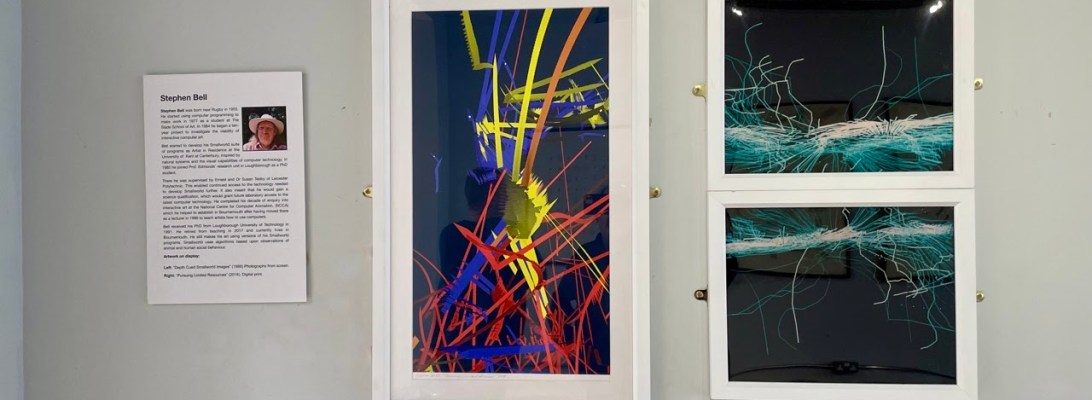
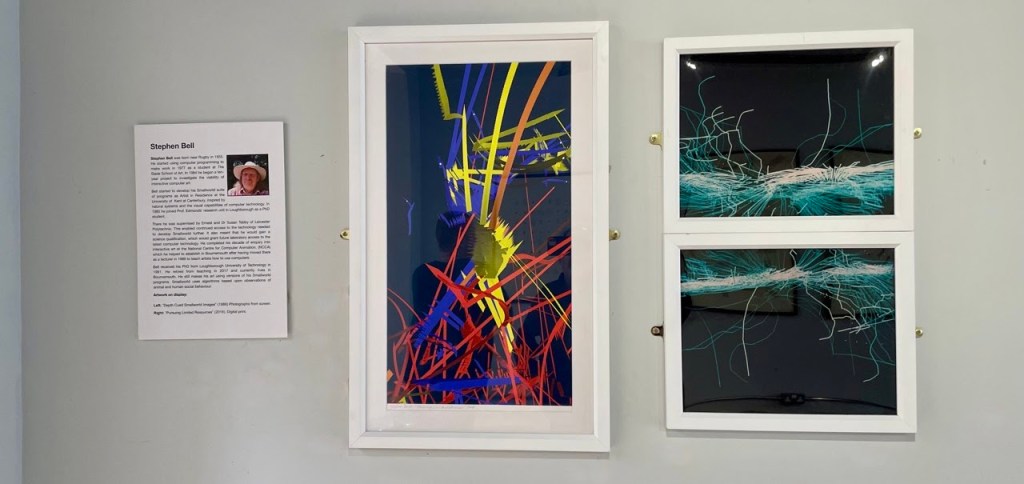
Pursuing Limited Resources (2018) and Depth Cued Smallworld Images (1989)

In April 2022, The above pieces were exhibited in an exhibition organised by Sean Clark at the start of a project to collect and display the role people and institutions in Leicester and Leicestershire contributed to the development of computational art.

More about the project and exhibition can be found here

A Zoom Event with the four artists exhibited is scheduled for 7.00pm London time on 28th April 2022. Register here